One brand rebuild, one full build, and a role that keeps growing with the agency.
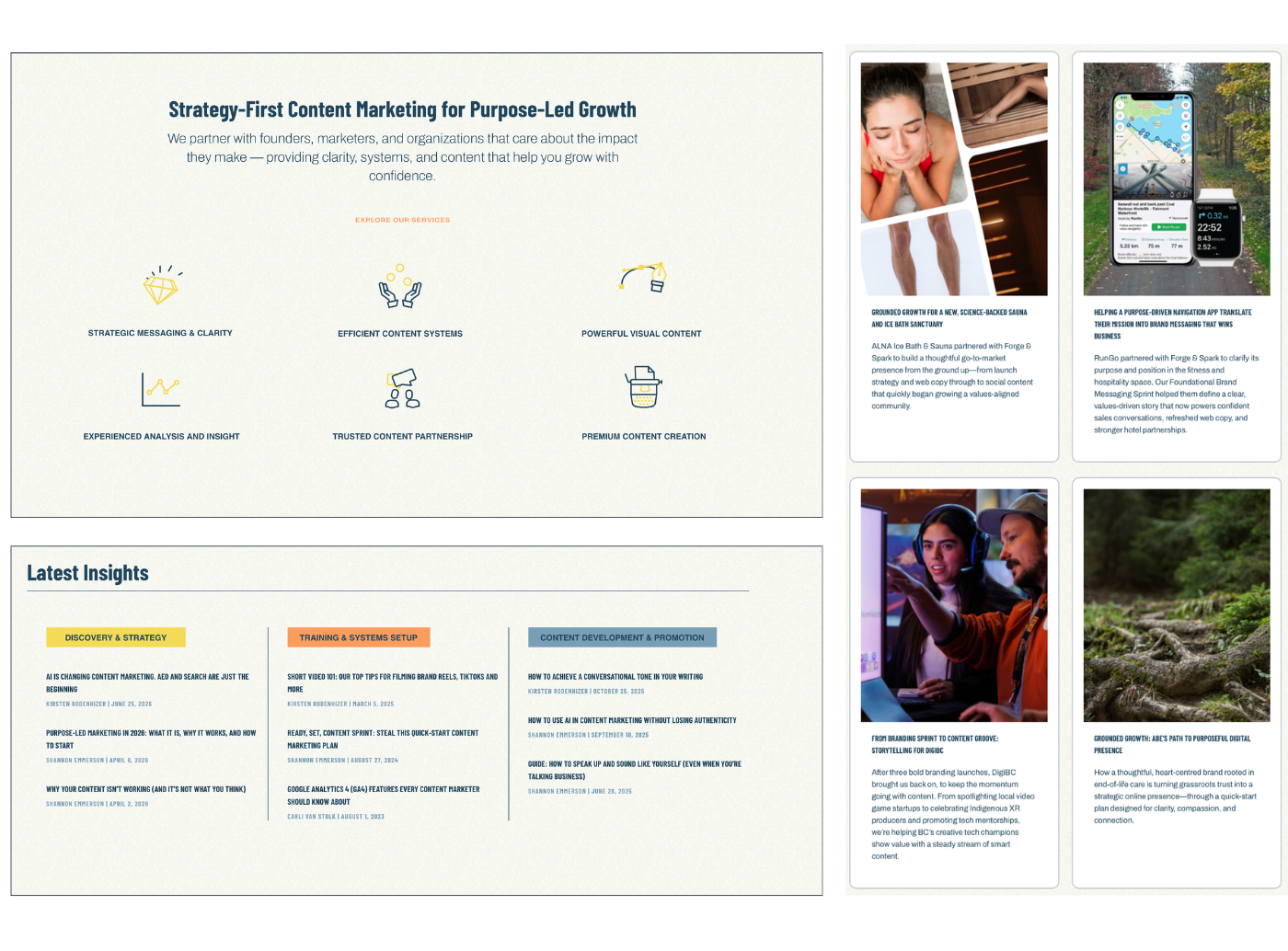
Forge & Spark is a content marketing agency helping purpose-driven brands drive real results through authentic, high-quality storytelling. The relationship with the agency has run for years and covers a lot of ground, but the part worth telling here is the brand itself: the Design Guidelines built for Forge & Spark, and what it takes to keep a brand consistent when a whole team is applying it every day, not just one person maintaining it alone.
Forge & Spark runs on a team of strategists, editors, and designers producing work constantly, client social packages, decks, proposals, blog and campaign content, the agency’s own site. All of it needs to look and read like Forge & Spark, regardless of who on the team built it or which channel it went out on.
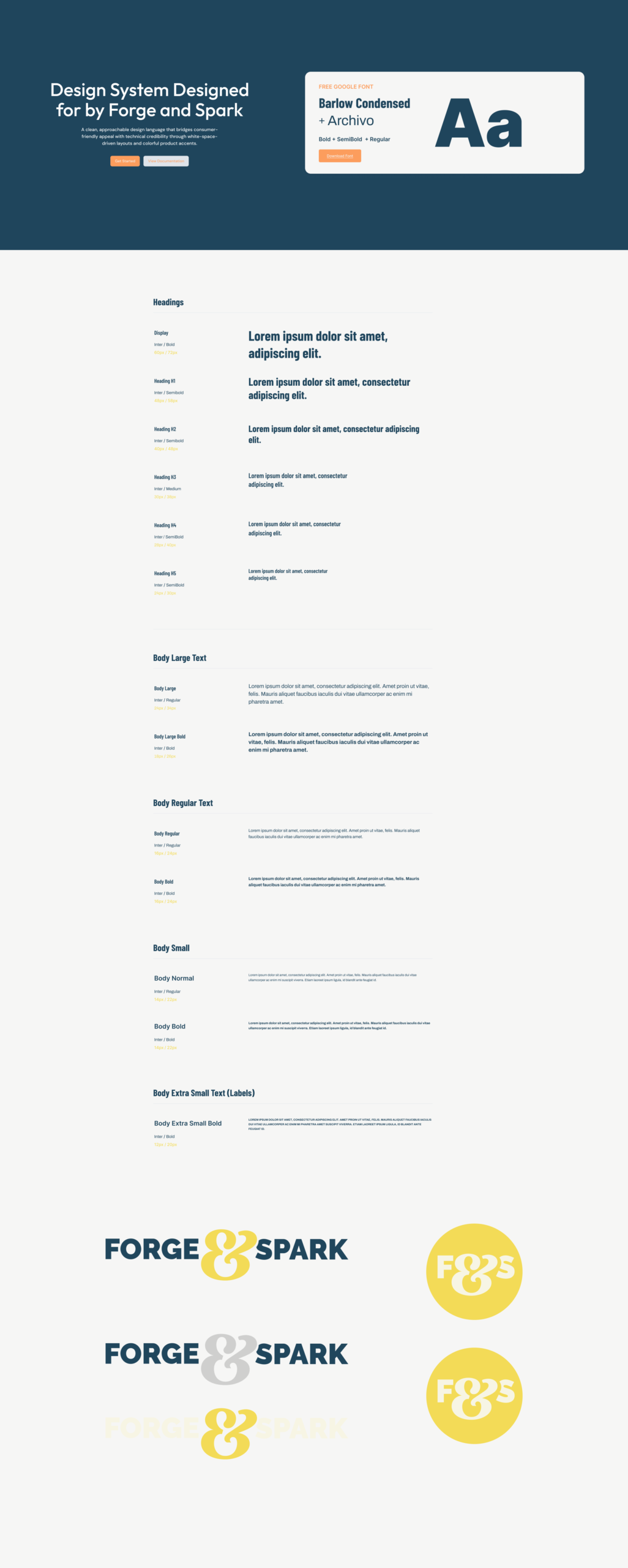
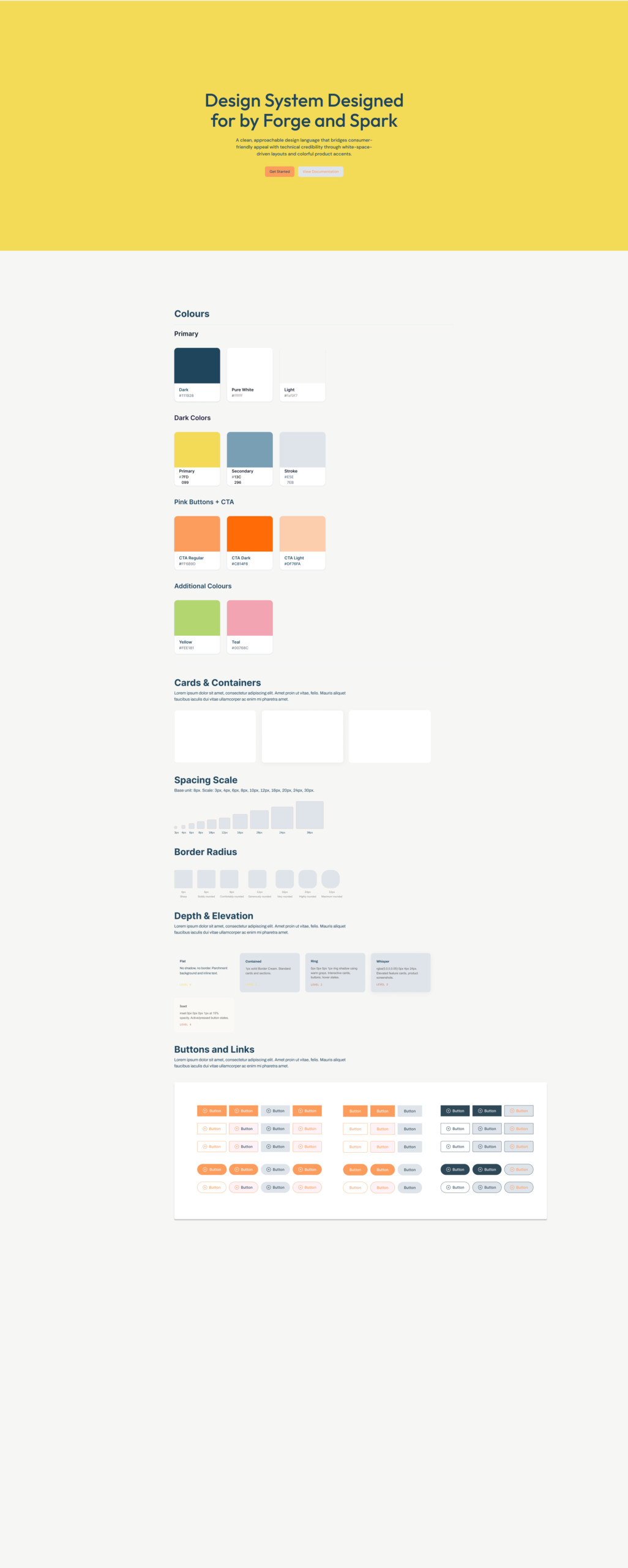
Design Guidelines were built as the working reference for exactly that: typography, colour, logo usage, visual hierarchy, and real usage examples, standardized into one place the whole team checks against instead of each person interpreting the brand on their own.
An agency that builds content strategy for other brands rarely gets to put the same rigor into its own. Forge & Spark’s brand needed the same foundation-first treatment given to clients, guidelines settled before anything got built on top of them, on a timeline that had to work around active client work rather than blocking it.
The bigger problem sat past the timeline. A brand that only one person understands is not a usable system, it is a bottleneck, and Forge & Spark runs on a team of strategists, editors, and designers, not one person applying the brand alone. Guidelines needed to be solid enough that a designer, a strategist, or a contractor picking up a project for the first time could apply the brand correctly without asking what the right version looks like.
That team produces across a wide range of channels at once, social graphics, client decks, proposals, the site itself, each with different formats and different constraints. A brand that only works cleanly on one channel and falls apart on the others is not actually solving the problem.
The team also changes over time, contractors rotate in, new designers join, and the brand still needs to hold its shape regardless of who is currently executing it. Past the initial work, the brand and the site do not stay still either. Services change, new offerings need pages and materials, and small needs come up unpredictably, a payment system gets scoped for an offering that then changes direction before it ships. None of that is a reason to let the brand drift. It is exactly what a working system has to survive.
Design Guidelines were built first, the same starting point as every engagement, giving Forge & Spark’s own identity the same foundation-first treatment its clients get: a cohesive visual system covering typography, colour, logo usage, visual hierarchy, and enough real usage examples that applying the brand to new work is a matter of checking the reference, not guessing at intent.
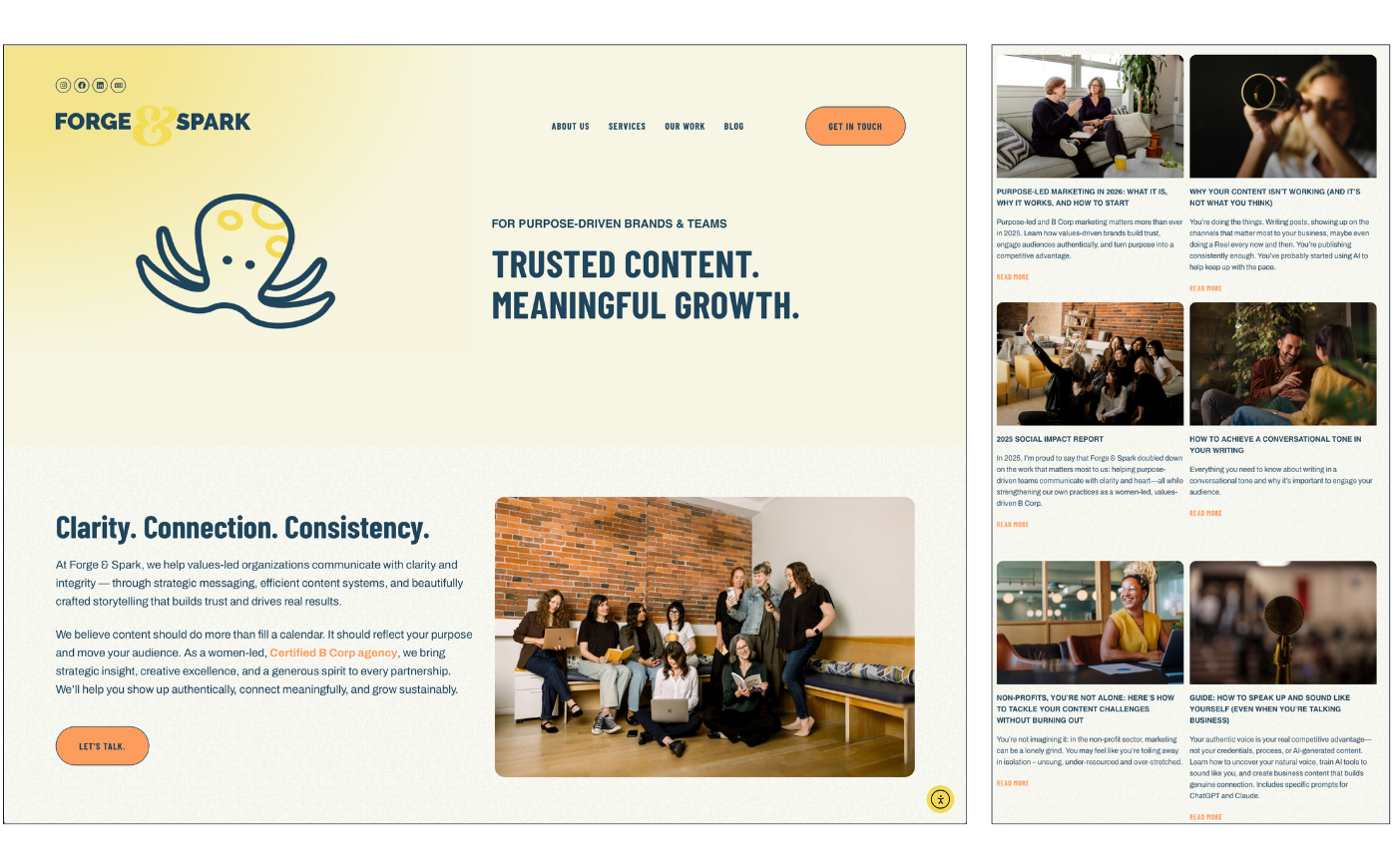
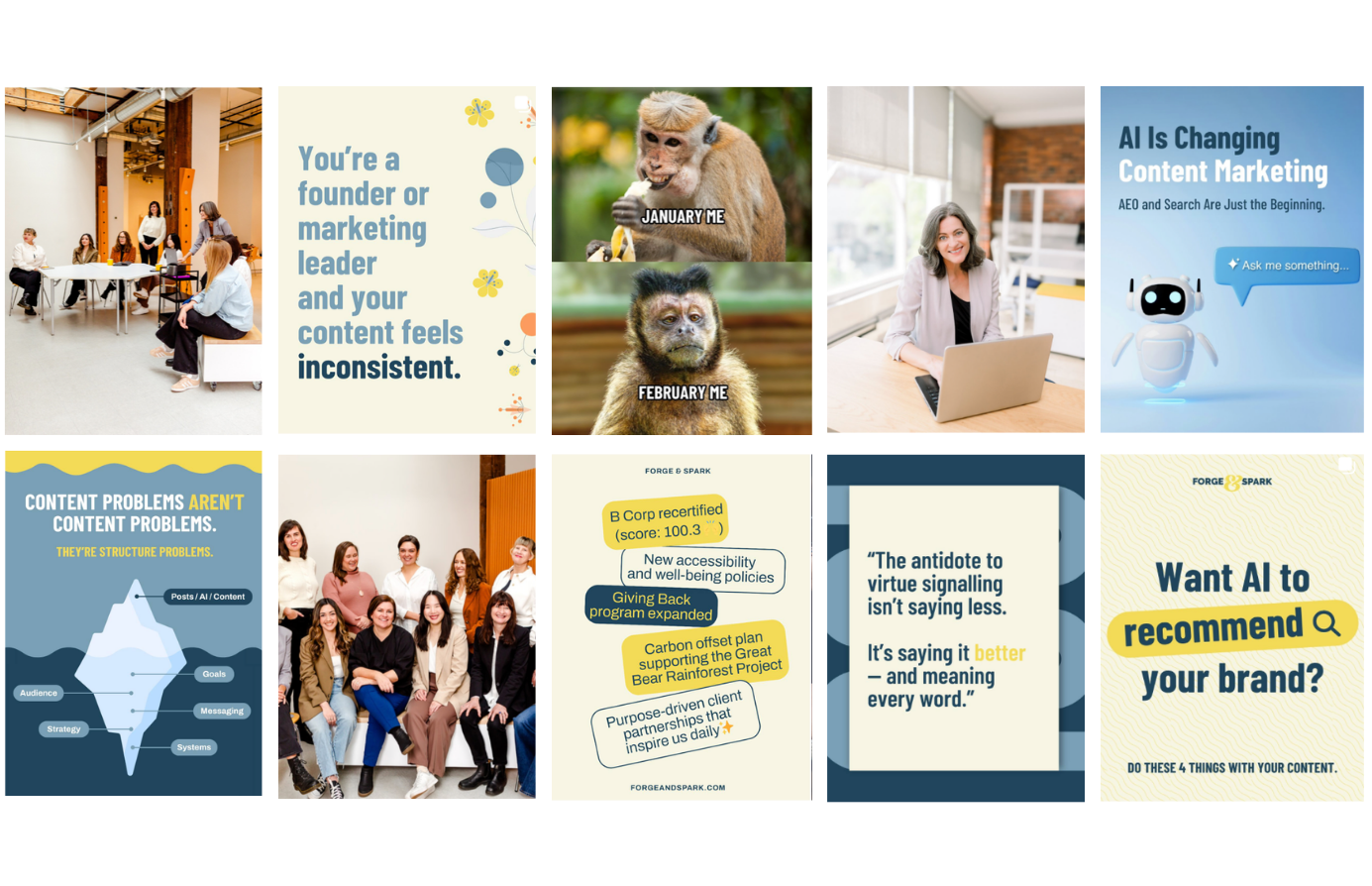
Because the team touches the brand across so many channels, the guidelines were built to answer the same question every time regardless of format: what does this look like as a social graphic, as a client deck, as a page on the site. One system, applied consistently, rather than a separate interpretation for each channel and each person using it.
The online build followed on top of the finished guidelines, hosted on Kinsta with a proper deploy pipeline, changes move through a staging environment before going live, so the site could be updated often without every update being a risk. The internal team was trained directly on it too, so day to day publishing and content updates do not need to wait on outside help.
Technical needs still come up unpredictably, and being ready for them matters as much as the guidelines themselves. WooCommerce was set up to support a planned payment flow for one service offering, and even though that offering ultimately went a different direction and the payment system was never used, the groundwork remains in place for whenever a similar need comes up again.
The relationship stays active specifically because a brand and a site are not one time deliveries. As Forge & Spark’s services, team, and tools change, both get revisited and extended rather than left to drift, including a current effort to plan how AI tools can plug into the site’s day to day operation without needing it rebuilt to support them.
The partnership continues today, longer than most single-project relationships last, because the role kept expanding as the agency’s own needs did.
Shannon Emmerson, Brand Messaging & Content Strategy Expert | Founder & CEO, Forge & Spark | Author of Content With Purpose — May 19, 2020, Shannon worked with Lara on the same team
“I’ve had the distinct privilege of working with Lara in a number of different ways over the past 15 or so years. She contributed interactive and video travel stories to several magazines when I worked with Canada Wide Media; she designed two of my own brand websites; and I worked alongside her at ECHO Storytelling to deliver several story-rich websites. She is, as you’ll note from these experiences alone, multi-talented, creative, energetic, passionate about storytelling, and able to get a whole lot of things done, and done to very high standards.”
Forge & Spark’s brand now holds up across a team producing constant output across a wide range of channels, social graphics, client decks, proposals, the site itself, without each new piece of work needing a check-in on what is on brand. The guidelines do that work instead.
New team members and contractors can pick up the brand and apply it correctly from existing reference rather than tribal knowledge, which matters for an agency whose team composition shifts over time. The site holds up the same way, a team that can publish on its own, and a technical partner who already knows the stack when something new comes up.
The relationship continues today, longer than most single-project relationships last, because the brand and the site keep needing tending, not fixing. It is a system built to be used constantly by people other than the person who built it, which is the actual measure of whether Design Guidelines succeeded in the first place.
The role has grown alongside that need. What started as brand and build work is now VP, Creative Strategy, creative direction across Forge & Spark and its clients, ownership of the brand and site, and leading how the studio adopts AI into its own creative workflows, the newest chapter in a relationship that keeps finding more to do rather than winding down.
One brand, several programs, one identity that holds them together.
A national brand for Canada's interactive industry, built in two weeks.
A brand and an online build for the Magazine Association of BC, and an ongoing partner for whatever new program comes next.